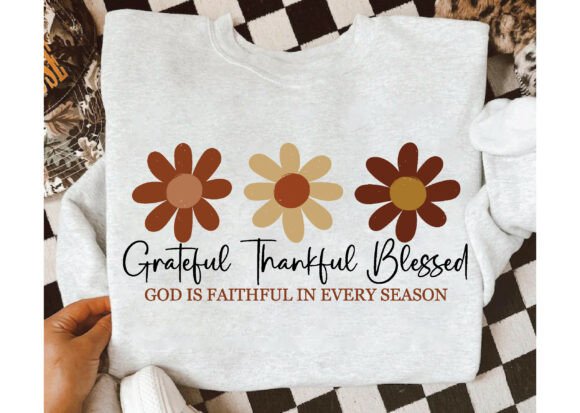
Grateful Thankful Blessed PNG, Christian
A Quiet Design That Carries Weight — Not Just Words
When I opened Grateful Thankful Blessed PNG, Christian for the first time, I didn’t see a slogan—I saw a mood. Soft curves in the lettering, gentle spacing, and a subtle floral or vine motif (often tucked beneath or framing the text) give it warmth without clutter. It doesn’t shout “faith.” It leans in—calm, grounded, sincere. That’s rare in T-Shirt Designs aimed at the Christian market, where bold fonts and heavy crosses often dominate. This one feels like something you’d stitch on a linen tea towel for a new mom, not a neon-lit gym shirt.
How It Actually Stitches — Real Fabric, Real Threads, Real Expectations
Last week, I used Grateful Thankful Blessed PNG, Christian to embroider a set of cotton canvas tote bags for a local boutique’s holiday launch. We chose light oat-colored fabric, medium-weight tear-away stabilizer, and soft ecru 40-weight thread. The result? Clean satin-stitched letters with just enough body—not too stiff, not too wispy. The word “Blessed” held its shape beautifully, even across the slight curve of the bag’s side seam. No puckering. No skipped stitches. That tells me the underlying digitizing respects fabric behavior—not just vector perfection.
It also translated well onto a lightweight cotton baby onesie (using cut-away + topping), though I did reduce the size by 10% to keep proportions friendly for tiny garments. On a structured twill cap? More cautious. The curved surface compressed the bottom of “Grateful” slightly, so I repositioned it higher on the front panel and added a light spray adhesive stabilizer layer. Worth the extra step—customers noticed the care.
Where It Shines—and Where It Needs Extra Attention
- Shines on: Sweatshirt embroidery (especially fleece-lined), pillow covers, aprons, nursery decor, personalized gifts for baptisms or baby showers, and boutique-branded kitchen towels.
- Needs caution on: Stretchy knits (like jersey t-shirts) without proper stabilization—those delicate curves can distort. Also, dark fabric demands careful thread color choice: a warm ivory works better than stark white for readability and softness. Tiny hoop sizes (under 4x4”) may require simplifying or omitting fine vine details—check your file’s smallest element before committing.
What It Does for Your Craft Business—Beyond the Stitch
As an Etsy seller and small shop product developer, I pay attention to how designs affect buyer trust and perceived value. Grateful Thankful Blessed PNG, Christian reads as intentional—not generic. When customers see it on a handmade product, they don’t think “mass-produced quote.” They think “thoughtfully made.” That lifts perceived value, especially in niches like faith-based gifting or slow-living home goods.
It also supports brand consistency. Whether you’re stitching it on a patch for a teen’s backpack or scaling it down for a monogrammed handkerchief, the design retains its quiet confidence. And yes—it photographs well. In printable mockups, it holds up in both natural light and flat-lay studio shots, which matters for digital embroidery file listings or social media previews.
Design Notes You’ll Want Before You Hoop Up
- Test the design on scrap fabric *first*—especially if using textured weaves (like burlap blends) or lightweight linens. Fill stitch density can behave differently than expected.
- Check thread color contrast on both light and dark backgrounds. A single shade won’t always work across your full product line.
- Review small details: Are the inner curves of “G” and “B” digitized with smooth satin stitch transitions—or are they tight, dense areas that might snag or wear faster?
- Confirm hoop size compatibility. Some versions include alternate layouts (centered, arched, vertical) — useful for caps or narrow bands on pillow edges.
- Use proper stabilizer: Tear-away for stable wovens, cut-away for knits, and a light water-soluble topper for fuzzy fabrics like fleece or terry cloth.
- Verify licensing. If you plan to sell finished products (embroidered patches, tote bags, baby blankets), confirm whether the embroidery file permits commercial use. Same goes for reselling the digital embroidery file itself.
Fitting the Right Moment—Not Just the Right Fabric
I recently stitched Grateful Thankful Blessed PNG, Christian onto a set of organic cotton napkins for a friend’s Thanksgiving table. No embellishment—just clean, centered embroidery in sage green thread. Guests kept commenting on how “peaceful” it felt—not preachy, not performative. That’s the sweet spot: when a machine embroidery design supports emotion instead of stating it.
It’s equally effective on a minimalist sweatshirt for a women’s wellness retreat or as part of a coordinated nursery set (blanket + onesie + wall art). But it wouldn’t suit a loud, graphic-heavy apparel line—or a high-contrast streetwear collection. Its strength is restraint. Its audience isn’t looking for volume—they’re looking for resonance.
A Final Thought for Designers and Makers
Good embroidery design isn’t just about technical accuracy. It’s about empathy—for the fabric, the machine, the maker’s time, and the person who’ll hold the finished product. Grateful Thankful Blessed PNG, Christian earns respect because it balances all four. It’s not flashy. It doesn’t need to be. It’s the kind of design that makes people pause, smile softly, and say, “Yes—that’s exactly right.”
If you’re building a craft business around meaning, mindfulness, or heartfelt gifting, this isn’t just another T-Shirt Designs download. It’s a reliable, quietly powerful tool—one that works as hard for your brand as it does for your stitch count.